
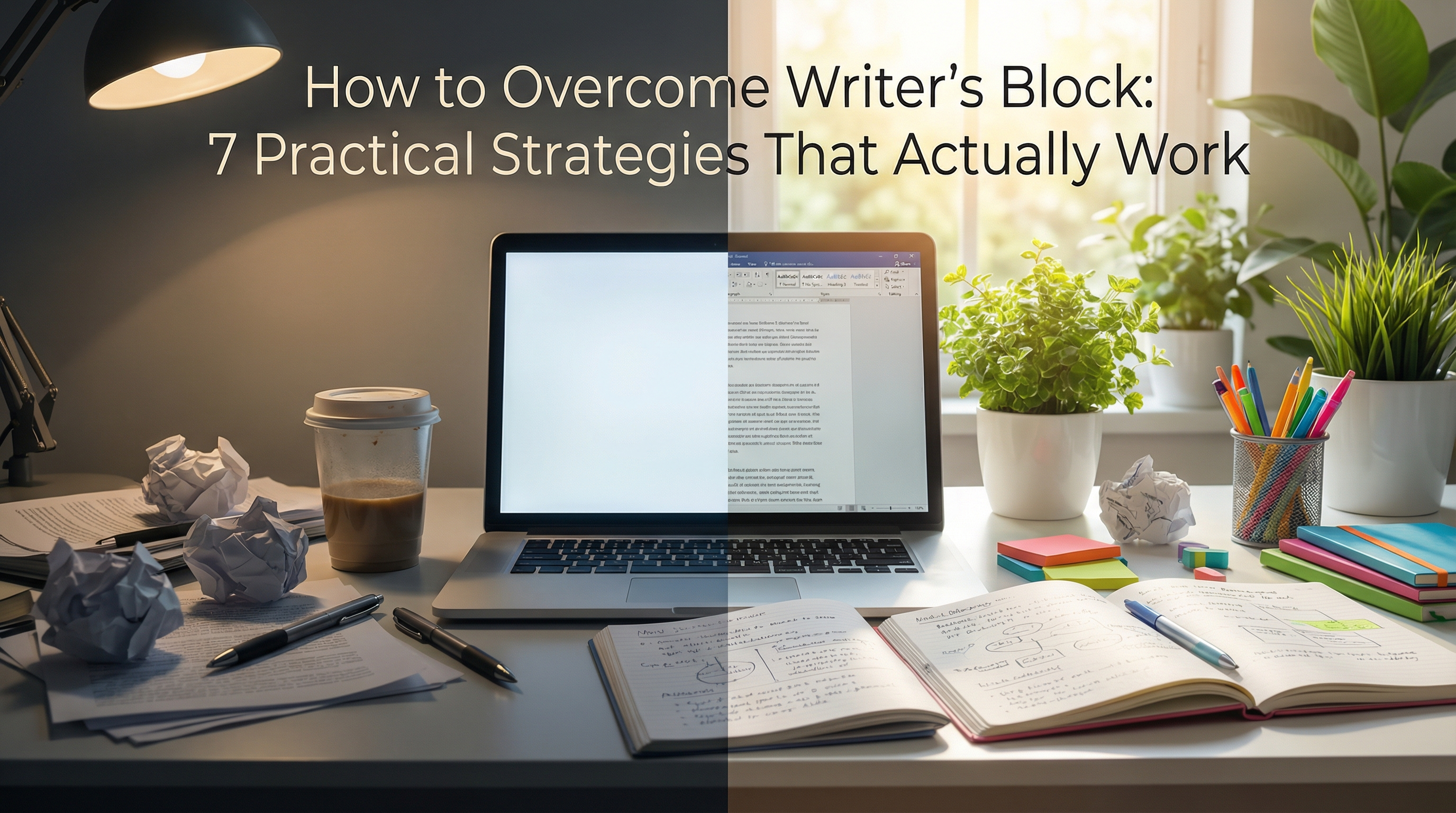
How to Overcome Writer's Block: 7 Practical Strategies That Actually Work
How to Overcome Writer's Block: 7 Practical Strategies That Actually Work
Every writer knows the feeling. You sit down, open your document, and... nothing. The cursor blinks mockingly. Your mind feels like a blank wall. Writer's block has struck again.
The good news? Writer's block isn't a mysterious creative curse. It's a solvable problem with practical solutions. In this guide, we'll explore why writer's block happens and share seven strategies that actually work to get your words flowing again.
Why Writer's Block Happens
Before we dive into solutions, it helps to understand what's really going on. Writer's block typically stems from one of these root causes:
Fear of imperfection. You're so worried about writing something bad that you can't write anything at all. The internal editor takes over before you've even started.
Decision fatigue. Too many possibilities paralyze you. Should your character go left or right? Should you start with dialogue or description? The options feel overwhelming.
Depleted creative reserves. You've been outputting without inputting. Your well of inspiration has run dry.
Unclear direction. You don't actually know what you're trying to say or where your story is going.
Once you identify which type of block you're facing, the solution becomes clearer.
Strategy 1: Lower the Stakes with Freewriting
When perfectionism is your enemy, freewriting is your weapon. Set a timer for 10 minutes and write continuously without stopping to edit, delete, or even think too hard. Write nonsense if you have to. Write "I don't know what to write" over and over until something else emerges.
The goal isn't to produce usable content—it's to break the seal of silence. Once words are flowing, even bad ones, good ones often follow.
Try this: Open a separate document (not your main project) and freewrite about your character's worst fear, a random childhood memory, or what they had for breakfast. You might be surprised what emerges.
Strategy 2: Start in the Middle
Who said you have to write in order? If your opening scene feels impossible, skip it. Jump to the conversation you're excited about, the climactic moment you can see clearly, or even the ending.
Writing out of order removes the pressure of "getting it right" from the start. Often, once you've written the exciting parts, the connecting tissue becomes obvious.
Strategy 3: Change Your Environment
Sometimes your brain associates your usual writing spot with the feeling of being stuck. A simple change of scenery can break the pattern.
Try writing at a coffee shop, in a different room, or even just facing a different direction. Some writers swear by writing in places with ambient noise; others need complete silence. Experiment to find what shifts your mental state.
Strategy 4: Feed Your Creative Input
You can't pour from an empty cup. If you've been writing intensively without taking in new experiences, ideas, or stories, your creative reserves may simply be depleted.
Take a deliberate break to consume. Read a book in a genre different from what you write. Watch a documentary about something you know nothing about. Take a walk and actually observe what you see. Have a conversation with someone whose life is different from yours.
This isn't procrastination—it's refueling.
Strategy 5: Use Constraints to Spark Creativity
Paradoxically, limitations often breed creativity. When everything is possible, nothing feels urgent. But when you impose constraints, your brain gets to work solving a puzzle.
Try giving yourself a specific challenge: Write this scene using only dialogue. Describe this setting in exactly 100 words. Tell this story from an unusual point of view. Write for 25 minutes without getting up.
Constraints transform the vague task of "write something good" into a concrete game to play.
Strategy 6: Talk It Out
Sometimes the ideas are there, but they're stuck in pre-verbal form. Talking can help translate them into words.
Explain your story to a friend (or even to yourself out loud). Record a voice memo describing what happens next. Have a conversation with your character—ask them questions and answer as they would.
Many writers find that once they've said something out loud, writing it down becomes much easier.
Strategy 7: Build an Inspiration System
The most sustainable solution to writer's block is preventing it in the first place. This means building a reliable system for capturing and organizing inspiration before you need it.
Keep a running collection of:
- Images that evoke emotion or atmosphere
- Snippets of overheard dialogue
- Interesting facts or historical details
- Character ideas or personality traits
- "What if" questions and story premises
- Quotes that resonate with your themes
When you sit down to write and feel stuck, you'll have a personal library of spark materials to draw from. Instead of facing a blank page, you're responding to prompts you've already collected.
The key is making this collection easily accessible and browsable. A chaotic folder of screenshots won't help you—an organized inspiration system will.
When You're Still Stuck
If you've tried multiple strategies and the block persists, it might be a signal worth listening to. Sometimes writer's block is your subconscious telling you that something in your story isn't working.
Ask yourself:
- Am I actually interested in this project, or am I writing it out of obligation?
- Is there a plot problem I've been avoiding?
- Have I taken a wrong turn somewhere that's making forward progress feel impossible?
Sometimes the most productive thing you can do is step back and reassess, rather than forcing words onto the page.
The Bottom Line
Writer's block feels like a wall, but it's really more like a door with a tricky lock. The right key depends on why you're stuck in the first place. Identify the root cause, apply the appropriate strategy, and give yourself permission to write badly on the way to writing well.
The words are there. Sometimes you just need the right approach to let them out.
Struggling with creative blocks? Muses is a writing tool designed specifically to help with inspiration—featuring mood boards, research materials, and AI brainstorming built right into your writing environment. Try it free